
Why Your Car is Jerking or Hesitating: Diagnostic 101
You hit the gas pedal expecting a smooth ride, but instead, your vehicle stumbles, jerks, or hesitates before picking up speed. This jarring experience is a common issue for many drivers and can leave you wondering if a major breakdown is right around the corner. Fortunately, understanding exactly why your car behaves this way is the first step toward a simple, stress-free fix.
Every driver knows the unique rhythm of their own vehicle. You know exactly how much pressure to apply to the brakes, how the steering wheel feels on the highway, and how the engine purrs when you accelerate from a stoplight. So, when that familiar rhythm is interrupted by a sudden jerk, shudder, or hesitation, it is completely natural to feel a wave of concern.
Nobody wants to deal with car trouble, but a vehicle that stutters when you press the gas pedal is trying to communicate with you. Your car is a complex machine made up of thousands of interconnected parts, and a hesitation is simply a symptom that one of those systems is out of sync. Whether you are navigating the daily bumper-to-bumper grind on the Schuylkill Expressway (I-76) or heading out for a weekend of shopping around the King of Prussia Mall, a sudden stutter from your vehicle can turn a routine drive into a stressful ordeal. While it might feel dramatic from the driver’s seat, the reality is often much less intimidating than you might think. By breaking down the most common culprits, you can approach the situation with confidence rather than anxiety.
Transmission vs. Engine: Identifying the "Jerk"
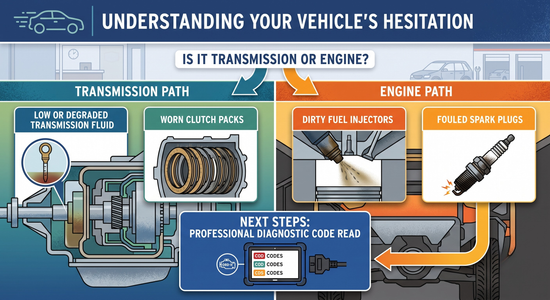
When you experience your car hesitating when accelerating, the very first step in diagnosing the problem is determining which major system is crying out for attention. In the vast majority of cases, this specific symptom points to one of two main areas: the transmission or the engine. But how can the average driver tell the difference?
Think of your car like a multi-speed bicycle. The engine represents your legs, providing the raw power and energy needed to move forward. The transmission represents the gears and chain, taking that raw power and efficiently transferring it to the wheels so you can actually move at varying speeds.
If the problem lies within the engine, the "jerk" will typically feel like a stutter, a loss of power, or a misfire. You might press the gas and feel the engine sputter, as if it is temporarily running out of breath before catching its stride again. This often happens consistently at certain RPMs or when you demand sudden power, such as when you are trying to accelerate up the steep incline of the Ben Franklin Bridge or merging into fast-moving traffic on the Blue Route (I-476).
On the other hand, if the issue is rooted in the transmission, the hesitation will feel distinctly different. It often presents as a hard, clunky shift, a delayed engagement when moving from park to drive, or a sensation that the engine is revving high but the car isn't moving forward as fast as it should. This is a classic sign of transmission slipping. If the jerk happens right at the moment your car should be shifting into a higher gear—perhaps just as you are cruising past Lincoln Financial Field on your way to a game—the transmission is the likely suspect.
The Transmission Culprit: Fluid Levels and Clutch Packs
If your intuition (and the symptoms) point toward the transmission, there is no need to panic. The transmission is an incredibly intricate piece of engineering, but many of its most common issues are highly treatable, especially when caught early.
One of the most frequent causes of a jerking transmission is simply low or degraded transmission fluid. Transmission fluid is the lifeblood of the system. It acts as a hydraulic fluid to facilitate gear shifts, a lubricant to prevent friction, and a coolant to keep temperatures down. Over time, this fluid can break down from intense heat and friction, or a small leak can cause the fluid levels to drop. When there isn't enough clean fluid to maintain the necessary hydraulic pressure, the transmission struggles to engage the gears smoothly. This results in the jarring, delayed shifts or transmission slipping that you feel behind the wheel. Often, a professional fluid exchange and leak check after a long summer of commuting across the Walt Whitman Bridge is all it takes to restore a buttery-smooth ride.
If the fluid levels are perfect and pristine, the culprit might be worn clutch packs. Inside an automatic transmission, clutch packs are stacks of alternating friction and steel plates that engage and disengage to change gears. After years of heavy driving, towing, or stop-and-go traffic on Route 1, the friction material on these plates can wear down. When they lose their grip, the transmission slips, causing a hesitation followed by a harsh jerk when the gear finally catches. While this requires more in-depth mechanical attention than a fluid top-off, a trusted technician can easily diagnose and address worn clutches before they lead to a complete transmission failure.
The Engine Culprit: Fuel Systems and Spark Plugs
If the transmission seems to be shifting smoothly but the car is still stuttering when you apply the gas, the engine is likely the source of the trouble. For an engine to run correctly, it needs a precise mixture of three things: air, fuel, and a spark to ignite them. If any one of these elements is compromised, you will experience an engine misfire, which feels like a violent jerk or hesitation.
Let's look at the fuel delivery system first. Every time you press the gas, fuel injectors spray a fine, perfectly measured mist of gasoline into the engine's cylinders. However, gasoline leaves behind carbon deposits and varnish over time. These microscopic deposits can clog the tiny nozzles of the fuel injectors, turning that fine mist into an uneven, weak dribble. When the engine is starved of fuel during acceleration, it hesitates. A professional fuel system cleaning is a highly effective maintenance service that dissolves these deposits, clears the injectors, and restores optimal fuel flow, instantly curing the hesitation and often improving your gas mileage in the process.
If fuel is flowing properly, the issue might be the ignition system—specifically, the spark plugs. Spark plugs are responsible for delivering the electrical current that ignites the air-fuel mixture inside the cylinder. Over tens of thousands of miles, the electrodes on the spark plugs slowly burn away, and they can become coated in oil or carbon ash. When a spark plug is fouled or excessively worn, it cannot generate a spark strong enough to ignite the fuel. This causes a "dead cylinder" misfire. You step on the gas, the engine tries to fire, but one cylinder fails, causing a distinct jerking motion. Fortunately, a routine spark plug replacement is one of the most straightforward and cost-effective engine repairs available. Upgrading to fresh, high-quality spark plugs brings the engine back to life, ensuring immediate, smooth power delivery.
Next Steps: The Power of a Professional Diagnostic
When your car is jerking or hesitating, it is easy to let your imagination run wild with visions of broken-down engines, stranded road trips along the Northeast Corridor, and exorbitant repair bills. Take a deep breath. As we've explored, the root cause is often a routine maintenance item like a fuel system cleaning, a spark plug replacement, or a transmission fluid top-off.
However, playing the guessing game with your vehicle is never a wise financial strategy. Replacing parts on a hunch—what mechanics call "throwing parts at a problem"—can quickly become expensive and frustrating, especially if the hesitation persists.
This is exactly why getting a professional diagnostic code read is your best next step. Modern vehicles are equipped with highly sophisticated onboard computers that monitor every sensor, valve, and shift point. When something goes wrong, the computer logs a specific diagnostic trouble code (DTC). While a cheap code reader from a hardware store might give you a vague number, a professional diagnostic at AAMCO goes much deeper.
Our expert technicians don't just read the code; they interpret the data, run pinpoint tests on the affected circuits, and visually inspect the components to find the true root cause of the problem. This middle-ground approach eliminates the guesswork. It ensures you only pay for the exact service your car needs, saving you significant money in the long run and preventing minor issues from snowballing into major breakdowns.
You don't have to live with a stressful, jerking vehicle. Regain your peace of mind and your smooth ride by scheduling a professional diagnostic today. Find your nearest trusted
Delaware Valley AAMCO center, and let our experts get you back on the road safely and comfortably.
Frequently Asked Questions (FAQs)
What exactly does it mean when my car hesitates when accelerating?
When a car hesitates during acceleration, it means there is a momentary delay or loss of power between the time you press the gas pedal and the time the vehicle responds. Instead of a smooth, linear increase in speed, the vehicle might stumble, buck, or feel like it is briefly stalling before it suddenly surges forward. This is not a quirk of the car; it is a clear symptom that the engine is not receiving the right balance of air, fuel, and spark, or that the transmission is struggling to engage the next gear. Addressing it promptly ensures the problem doesn't escalate.
How can I tell if "transmission slipping" is causing the jerk?
Transmission slipping has a very distinct feel compared to an engine misfire. If your transmission is slipping, you will often notice that the engine RPMs (the tachometer needle on your dashboard) spike upward, and you can hear the engine roaring louder, but the car does not accelerate proportionately. The "jerk" usually occurs when the transmission finally catches the gear and slams into place. You might also notice this happening specifically when the car is trying to automatically shift from one gear to the next, such as moving from second to third gear, rather than a constant stuttering feel.
Will a fuel system cleaning really fix my car's hesitation?
Yes, if the hesitation is caused by clogged or dirty fuel injectors, a professional fuel system cleaning will absolutely fix the problem. Over time, carbon deposits build up in the fuel injectors, intake valves, and combustion chambers. This buildup restricts fuel flow, causing the engine to run "lean" (too much air, not enough fuel). A professional cleaning uses highly concentrated, pressurized solvents that safely dissolve these deposits. Once the fuel injectors can spray a clean, atomized mist of fuel again, your engine will regain its smooth idle and seamless acceleration.
How often should I get a spark plug replacement?
The interval for a spark plug replacement varies heavily depending on the make and model of your vehicle, as well as the type of spark plugs installed. Older vehicles with standard copper spark plugs generally require a replacement every 30,000 miles. However, most modern vehicles use platinum or iridium spark plugs, which are incredibly durable and can last anywhere from 60,000 to 100,000 miles. Check your owner's manual for the exact mileage interval. If your car is hesitating, misfiring, or suffering from poor gas mileage before that milestone, it is a good idea to have them inspected early.
Is it safe to drive my car if it's jerking or hesitating?
It is highly recommended that you minimize driving if your car is actively jerking or hesitating. While you may be able to get the car to the store or safely back home, continuing to drive under these conditions can be risky. A sudden loss of power while pulling out into an intersection or merging onto a highway can pose a serious safety hazard. Furthermore, driving a car with a severe misfire or a slipping transmission can cause significant collateral damage to other expensive parts, such as the catalytic converter or the internal transmission hard parts.
What happens during a professional diagnostic code read?
During a professional diagnostic code read at a trusted center like AAMCO, a certified technician connects a sophisticated, high-level scan tool to your vehicle's On-Board Diagnostics (OBD-II) port. This scanner downloads the specific error codes stored by your car's computer. But the process doesn't stop there. The technician reviews live data streams, checking sensor voltages, fuel trim levels, and transmission fluid pressures in real-time. This comprehensive data allows the technician to pinpoint exactly which system is failing, moving beyond a simple check engine light to find the exact mechanical or electrical fault.
Why shouldn't I just use a cheap code reader at home?
While budget-friendly code readers from auto parts stores can tell you a basic "P-code" (like P0300 for a random misfire), they do not tell you why the code triggered. A misfire code could be caused by a bad spark plug, a faulty ignition coil, a vacuum leak, a dead fuel injector, or low engine compression. If you rely solely on a cheap code reader, you might end up buying and replacing parts you don't actually need, wasting time and money. Professional diagnostic equipment provides in-depth data and bi-directional controls that allow technicians to isolate the exact root cause accurately the first time.
Will fixing a hesitating car be overwhelmingly expensive?
Not necessarily! This is a common fear, but the reality is that many hesitations are caused by minor, routine maintenance issues. A spark plug replacement, a new fuel filter, a professional fuel system cleaning, or a transmission fluid top-off are all relatively inexpensive services that can completely cure a jerking car. The key to keeping costs down is early intervention. By bringing your vehicle in for a professional diagnostic at the first sign of trouble, you catch these minor issues before they place undue stress on major components, saving yourself from heavy repair bills down the road.
Share